Instagram Just Hit 3 Billion Monthly Users: Here's What That Actually Means
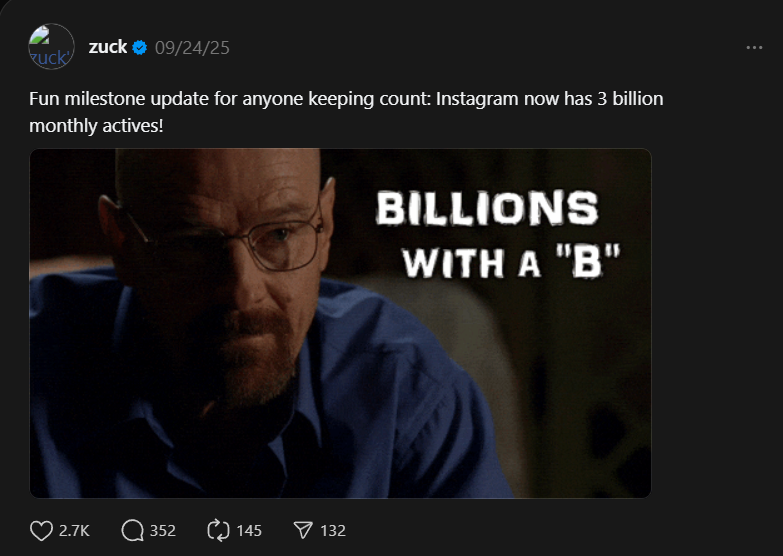
Instagram Just Hit 3 Billion Users: Here's What That Actually Means Three billion. That's billion with a "b," as Mark Zuckerberg emphasized this week with a Breaking Bad GIF on his Threads post. Instagram has officially reached 3 billion monthly active users, and honestly? It's kind of mind-blowing when you stop to think about what that number represents. That's nearly 37% of everyone on Earth. If Instagram were a country, it would be bigger than India, China, the U.S., and the entire European Union combined. No empire in human history, virtual or otherwise, has ever reached this many people this quickly. But here's the thing: while the headline number is impressive, the real story is about what Instagram is becoming and how it's changing to stay on top.
From Photo App to Everything App
Remember when Instagram was just a place to post square photos with Valencia filters? Yeah, those days are long gone.
Adam Mosseri, Instagram's head honcho, dropped some pretty revealing stats this week: "If you look at the last few years, almost all of our growth has been driven by DMs, Reels, and recommendations."
Read that again. The growth isn't coming from people posting more photos of their brunch or vacation. It's coming from private messages, short videos, and content from accounts you don't even follow.
"People think of us — they think of a feed of square photos, but that's just not how people use Instagram and hasn't been for a long time now," Mosseri said in a recent interview.
That's a pretty stark admission from the guy running the show. Instagram isn't the app we think it is anymore. It's evolved into something completely different.
The Big Redesign: What's Actually Changing
Instagram isn't just celebrating this milestone and calling it a day. They're making some pretty significant changes based on how people actually use the app now.
The Upload Button Is Getting Replaced
This one's pretty symbolic. That center button on the bottom navigation bar, the one you tap to post a photo? It's being replaced with a direct shortcut to your DMs.
Think about what that says. The company is literally removing the "post" button from the main navigation because private messaging has become more important than public sharing. For an app that started as a photo-sharing platform, that's a huge shift.
Reels Are Taking Center Stage
Instagram is testing something pretty radical in India and South Korea: when you open the app, it'll go straight to Reels instead of your traditional feed. Users will need to opt in, but if the feedback is good, this could roll out globally.
Why these markets first? Well, TikTok is banned in India, which makes it Instagram's biggest testing ground without direct competition. And both markets are huge for mobile video consumption.
"It's very possible that TikTok ends up back in India, and so we want to make sure that we are not being complacent in one of our most important countries," Mosseri explained.
"Dear Algorithm" Gets a Response
Here's something kind of funny and surprisingly useful. Instagram noticed people posting things like "Dear Algorithm, please show me more mid-century furniture" or "Dear Algorithm, I want Seattle Mariners content."
So they're actually building a feature that lets you directly tell the algorithm what you want. You'll be able to go into settings and add specific interests or topics, and Instagram will adjust what shows up in your Reels feed accordingly.
It's a more explicit way of controlling your feed, compared to the usual implicit signals like who you follow or what you like. And according to Mosseri, it's only possible now because of advances in AI that can better understand and label content automatically.
The Numbers Behind the Growth
Let's break down how Instagram got here, because the growth trajectory is actually pretty wild.
The Timeline:
- June 2018: 1 billion users
- December 2021: 2 billion users
- May 2025: 3 billion users
That means Instagram tripled its user base in about seven years. For context, Facebook hit 3 billion in January 2025 at 21 years old. Instagram is getting there at just shy of 15 years old. It's the prodigy of Meta's family of apps.
The platform has been adding users at a pretty steady clip too. According to reports, Instagram was bringing in over 70 million new users annually since 2020, with a massive surge of 170 million between 2020 and 2021. Even as the market matured, they still added 40 million users between 2024 and 2025.
Current Usage Stats:
- US adults spend an average of 33.1 minutes per day on Instagram
- Younger users (18-24) spend 53 minutes daily
- Average session: 12 minutes and 10 seconds
- Pages viewed per session: about 9.82
- Bounce rate: 50.34%
Those engagement numbers matter because they show people aren't just opening the app and leaving. They're exploring, scrolling, and sticking around.
But Wait, There's a Catch
Here's where things get interesting, and maybe a little less impressive than the headline suggests.
Meta counts "Monthly Active Users" (MAUs), which basically means anyone who logs into Instagram at least once in a 30-day period. But what does that really tell us?
I'll use myself as an example. Technically, I'm one of those 3 billion users. I look someone up via their handle once or twice a month. I posted two whole photos in 2024. My Screen Time shows I average 18 seconds a day on Instagram.
Am I really an "active user" in any meaningful sense? Probably not. But I count in that 3 billion.
The TikTok Comparison Everyone's Making
Here's where things get really interesting. TikTok has about 1.6 billion monthly active users, less than half of Instagram's number. But TikTok users spend an average of 56 minutes per day on the app, compared to Instagram's 32 minutes.
Do the math:
- Instagram: 3 billion users × 32 minutes = 96
- TikTok: 1.6 billion users × 56 minutes = 89
Instagram still wins, but not by as much as you'd think from the user count alone. And that 32 minutes per day on Instagram? It hasn't really moved since 2022, while it was growing every year before that.
That plateau should worry Instagram, and I think it's exactly why they're making all these changes now.
What Reels Really Mean for Instagram
Let's talk about Reels for a minute, because this is arguably the most important shift Instagram has made in the last few years.
Reels launched in mid-2020 as Instagram's answer to TikTok, and it's been absolutely massive. According to Meta, Reels now account for 50% of all time spent on Instagram. That's half of everyone's scrolling time going to short-form video.
People share 3.5 billion Reels daily across Facebook and Instagram combined. That's not views, that's shares. The actual view count must be astronomical.
Mosseri is pretty frank about it: most of the videos you see on Instagram are recommended content from accounts you don't follow. The algorithm is doing the heavy lifting now, not your curated follow list.
This is a fundamental change from what made Instagram special in the first place. It used to be about keeping up with friends and accounts you chose to follow. Now it's about discovering content the algorithm thinks you'll like, regardless of the source.
The Cultural Relevance Problem
Despite hitting 3 billion users, there's something Instagram seems genuinely worried about: staying culturally relevant.
"The most likely outcome for a large platform like ours is that we shrink eventually. Or maybe we grow, but we become less culturally relevant," Mosseri said. "It's not just about the metrics. It's about – does culture break on Instagram? Do interesting things happen on Instagram? Are we part of the zeitgeist?"
That's a surprisingly honest concern. They're looking at Facebook, which also has 3 billion users but has definitely lost its cool factor, especially with younger people. Instagram doesn't want to become the next Facebook in terms of cultural perception.
The problem is, many of the changes Instagram is making to chase growth feel like they're moving away from what made the platform special. The focus on algorithmic recommendations over friends' posts, the pivot to video over photos, the emphasis on DMs over public sharing—these all change the fundamental nature of the experience.
What This Means for Users (That's You)
So what should you actually expect from Instagram going forward?
More Video, Less Photos
If you're someone who still primarily posts and views photos, you're increasingly not Instagram's target user. The app is becoming a video-first platform, and that's only going to intensify.
Less Control Over Your Feed
Even with the new "Dear Algorithm" feature, you're still seeing more recommended content and less content from people you actually follow. That's not changing anytime soon.
DMs Are the New Posts
If you've noticed you're sharing more stuff privately with friends instead of posting publicly, you're part of the trend Instagram is betting on. Expect more features focused on private sharing.
The iPad Finally Gets Love
Somewhat randomly, Instagram just launched a proper iPad app after years of refusing to do so. And guess what it opens to? Reels. That tells you everything about where the platform's priorities are.
The Legal Elephant in the Room
There's one thing worth mentioning: Instagram's future might not entirely be up to Mark Zuckerberg.
The Federal Trade Commission has a case going that argues Meta is an illegal monopoly in social media, and they're specifically targeting the acquisitions of WhatsApp and Instagram. A federal court decision is expected sometime in late 2025 or early 2026.
If the FTC wins, Meta could be forced to spin off Instagram as a separate company. That would be absolutely massive, though legal experts seem split on whether it'll actually happen.
Internal emails that have surfaced during the trial show some interesting tensions. Zuckerberg has apparently expressed concern that Instagram's cultural relevance is contributing to Facebook's decline among young people. Instagram has become the cool younger sibling, and that's created some internal dynamics at Meta.
My Honest Take on All This
Look, 3 billion users is objectively impressive. Building anything that a third of humanity uses is a massive achievement, and Instagram deserves credit for that.
But I can't help feeling a bit nostalgic for the Instagram of the 2010s. The one that was actually about photography, about following interesting people and seeing what they were up to. The one where your feed showed you posts from people you chose to follow, in chronological order.
That app is gone. What we have now is a video recommendation engine with a messaging app bolted on. That's not necessarily bad—lots of people clearly love it given the numbers—but it's fundamentally different.
The changes Instagram is making make sense from a business perspective. They're responding to where user behavior is actually going, not where we wish it would go. Private sharing is up, public posting is down. Short video dominates attention spans. Algorithm-driven discovery keeps people scrolling longer than chronological feeds from friends.
But there's something a bit sad about replacing the upload button with a DM shortcut. It feels like Instagram is admitting defeat on its original vision.
What Happens Next?
Instagram will keep growing, at least for a while. There are still billions of people coming online for the first time, especially in markets like India. The platform has room to run.
But the real battle isn't about user count anymore. It's about time and attention. It's about whether Instagram can keep people engaged for longer, whether it can fend off TikTok and whatever comes next, and whether it can stay culturally relevant as it ages.
The moves they're making—emphasizing Reels, pushing DMs, letting users customize their algorithm—are all aimed at those goals. Whether they work remains to be seen.
One thing's for sure: the Instagram we'll have in 2030 will probably be as different from today's Instagram as today's is from 2010's. The question is whether we'll like it as much.
For now, Instagram is on top of the world with 3 billion users. That's an empire any platform would kill for. But as Mosseri seems to understand, empires don't last forever just because they're big. They need to keep evolving, keep mattering, keep being part of the conversation.
Whether Instagram can pull that off while fundamentally changing what it is? That's the billion-dollar question. Or should I say, the 3-billion-user question.